The Basque Country gets ahead of what Europe will require in 2031
At the Health Data Forum in Bilbao, Osakidetza and Genomcore presented OSAGEN, a genomics platform that brings innovation into clinical practice, with pharmacogenomics as its first use case, already being rolled out
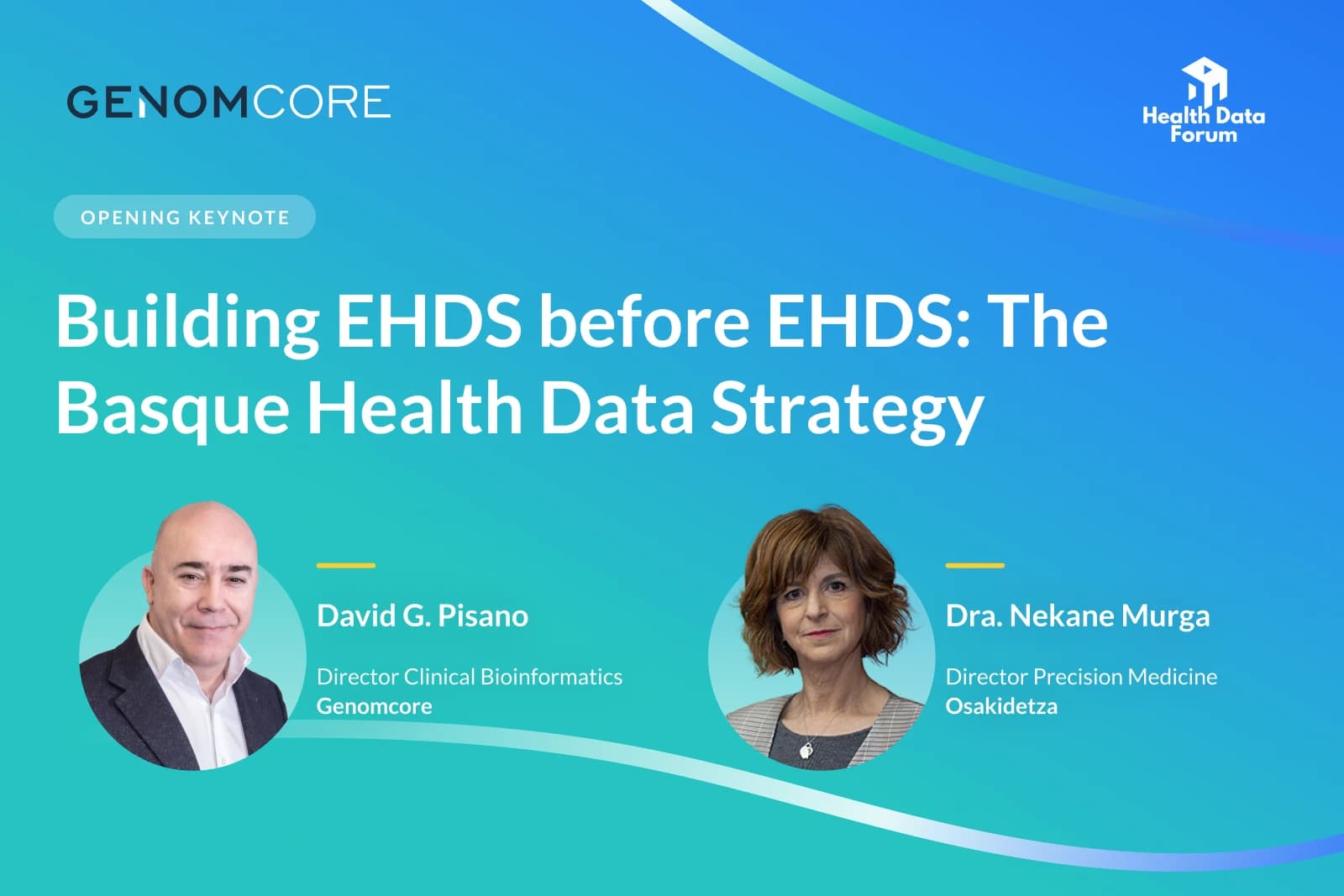
On September 24, at the Health Data Forum in Bilbao, Nekane Murga, Director of Healthcare Planning, Organization and Evaluation at the Basque Department of Health, and David G. Pisano, Director of Clinical Bioinformatics at Genomcore, gave the talk "Building the Euskadi Health Data Space before the European Health Data Space". The instrument is OSAGEN, the genomics platform of the Basque public health system, owned by Osakidetza and developed with Genomcore as its technology partner.
Regulation (EU) 2025/327 on the European Health Data Space (EHDS) entered into force in March 2025 and sets out a framework for health data to be interoperable, structured and managed under public governance. It applies in phases: primary use of data and the patient summary will arrive in 2029, and genomic data for secondary use, that is, its reuse for research and innovation, will not be mandatory until March 26, 2031. Genomic data is the most sensitive kind, because it is personal, it affects the family and it is predictive. These are the capabilities the regulation will progressively require, and the ones Osakidetza and Genomcore have been building with OSAGEN since 2023.
We have worked together with [Genomcore] on our genetic data platform, OSAGEN.

OSAGEN: the genomics platform of the Basque public health system
Osakidetza, the Basque Health Service, covers just over two million people, with a unified electronic health record and a laboratory network with a single test catalog. Four reasons underpin its commitment to genomics: personalized medicine, equity for all Basque citizens, sustainability and data sovereignty, as data must live within a public, governed and trusted framework.
What we seek as an organization, above all, is the wellbeing of the population and prevention. And there is nothing better for prevention than having people's genetic information accessible from the health record.
For Osakidetza, this did not start as a technology project but as a strategic decision: faced with genetic data scattered across centers and systems, it chose a single platform with a common policy for the whole network. Until then, genetic studies were stored in databases, hard drives and clouds, and their reports remained as PDFs with no access for the patient's subsequent clinical pathway. OSAGEN was born from that decision, with one shared foundation for care and research.
Genomcore is Osakidetza's technology partner. Its platform, Genomcore BIMS, is the infrastructure OSAGEN runs on: it brings genomic variants together in a single repository, where they are processed and annotated according to reference guidelines. The result is a structured clinical report that is integrated into Osabide, the electronic health record, with no manual steps. That same foundation feeds research, with a single source of data. Public healthcare sets the course and makes the decisions, and Genomcore provides the technology that puts them into practice.
Pharmacogenomics in the Basque public health system, on its way to the consultation room
Among the use cases Osakidetza set out when designing the platform is pharmacogenomics, one of the most innovative. This discipline analyzes the genetic markers that determine how each person metabolizes a drug, in order to prescribe the right drug and dose for their profile. For decades, patients have been treated with the best available protocol, designed for the average patient, but each person responds differently: a prodrug may fail to activate and have no effect, while another drug may build up in the blood and become toxic. A genetic study keeps its value throughout the patient's life and can guide the prescription of painkillers, sedatives or antiplatelet drugs years later.
In OSAGEN, this use case has been developed and is being integrated with prescribing. The laboratory system (GestLab) requests the drug-specific study from OSAGEN, OSAGEN returns a pharmacogenetic report, a clinician validates it and the platform generates an alert in Osabide code format. The alert will appear in the health record, next to allergies, linked to prescribing: if the drug will not be effective or requires a dose adjustment, the prescriber will be notified at the moment of the decision. A technical committee defines which findings trigger alerts, and the result stays with the patient for life.
The first drug in the pilot is clopidogrel, a widely prescribed antiplatelet drug and a prodrug: in poor metabolizers it is taken without reducing the likelihood of stroke, coronary stent occlusion or thrombosis. The rollout is moving from validated alerts to routine prescribing, and Murga expects to extend the program to around 30 or 40 drugs.
That we can give the right drug in the context of the patient, in a personalized way.
Hereditary cancer and SIGenES, the national variant library
Alongside pharmacogenomics, hereditary cancer is OSAGEN's second use case already underway. When a genetic variant is studied in a patient with suspected hereditary cancer, interpreting it, that is, deciding whether or not it is pathogenic, is the hardest and most valuable part of the process, and it makes no sense for every region or every hospital to repeat it from scratch for the same variant. That is why SIGenES exists: the National Variant Library of the Spanish National Health System, to which the genomic variants of the Spanish public system are reported, with coverage reaching some 49 million citizens. A variant interpreted in the Basque Country becomes standardized and available to any other region, and OSAGEN is what connects the Basque Country to that shared national knowledge.
Data leaves the Basque node standardized and pseudonymized, through encrypted transfer. Pisano illustrated it this way: when a patient in Donostia presents a new variant and someone in Murcia has already interpreted it, the care process speeds up. The platform also has research areas configured, such as UMEGEN and IMPACT.
The Basque health data space, ahead of the European one
Europe will require genomic data for secondary use in 2031, and OSAGEN processes and reports genomic variants today. It will ask for interoperable primary-use data in 2029, and the platform is integrated live with Osakidetza's health record. It will ask for structured, reusable data, and OSAGEN generates standardized clinical reports. It will ask for a governed and trusted framework, and the Basque Country has a public genomics platform in production. Pisano clarified that these are parts of the data space, in the context of genetics.
A platform that is alive, that is working, that is serving patients in the Basque Country.
The next step is to bring the rest of the configured use cases into production and for the Basque data space to serve as a model for the European one.
In practice, the Basque Country is already building what Europe will require, years before it becomes mandatory. The title of the talk, "Building the Euskadi Health Data Space before the European Health Data Space", was no play on words: the Basque health data space was built before the European one. The Basque Country did not arrive at the EHDS on time. It arrived early.
OSAGEN is a public program developed by Osakidetza with Genomcore, funded and supported by the European Union (NextGenerationEU), the Spanish Ministry of Health, the Digital Health Strategy and the Recovery, Transformation and Resilience Plan.